

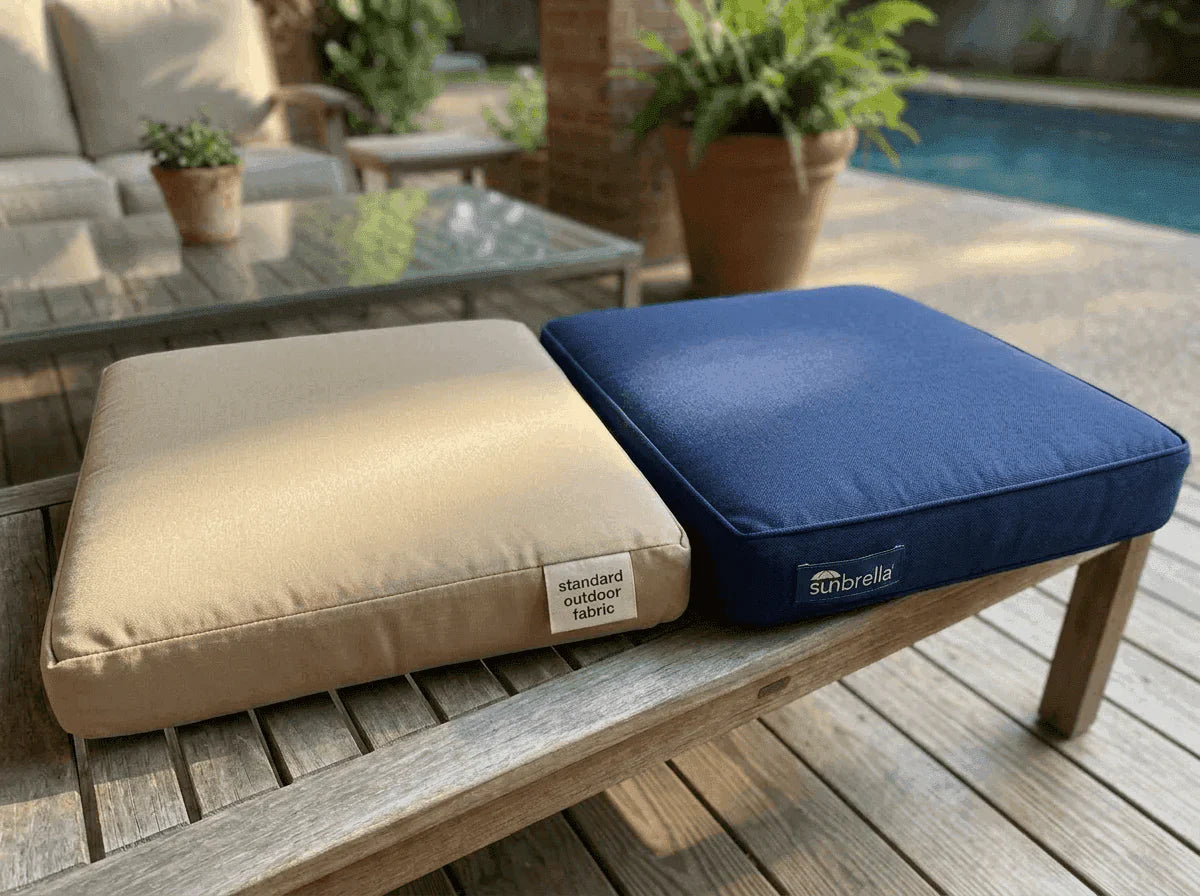
Quick Answer
| You do not always need Sunbrella fabric for outdoor cushions. Sunbrella is one of the best premium outdoor fabrics for extreme sun, coastal environments, and commercial use. For most residential patios, decks, and covered outdoor spaces, a quality solution-dyed outdoor fabric can provide strong UV resistance, water resistance, and easy cleaning at a more affordable price. The right choice depends on your climate, sun exposure, usage, and budget. |
In This Guide:
1. What Is Sunbrella Fabric?
2. What Makes an Outdoor Fabric “Good”?
3. Sunbrella vs Standard Outdoor Fabric
4. When Sunbrella Is Worth It
5. When You Do Not Need Sunbrella
6. Does Fabric Choice Affect Cushion Life?
7. Does Fabric Affect Cleaning?
8. How to Choose Based on Your Climate
9. Favoyard’s Approach: Standard Fabric + Sunbrella Option
10. FAQ
Sunbrella is one of the most recognized names in outdoor fabric, and for good reason. It has a strong reputation for UV resistance, color retention, and long-term outdoor performance.But that does not mean every outdoor cushion needs to be made with Sunbrella.
For many homeowners, the real question is not “Is Sunbrella good?” — it is “Is Sunbrella
necessary for my specific situation?”
This guide explains what Sunbrella offers, what a quality standard outdoor fabric can also do, and how to decide which is the better choice for your patio furniture.
What Is Sunbrella Fabric?
Sunbrella is a brand of solution-dyed acrylic outdoor fabric known for high UV resistance,
strong colorfastness, and long-term durability. It is widely used for outdoor cushions, awnings, marine upholstery, and commercial outdoor furniture.
Because it is solution-dyed, the color goes into the fiber before the fabric is finished,
rather than being applied only to the surface. This helps the fabric resist fading even after
extended sun exposure.
Sunbrella is often considered a premium option for customers who want maximum outdoor performance and a wide selection of established colors and patterns.
What Makes an Outdoor Fabric “Good”?
A good outdoor fabric is not defined only by its brand name. For most cushion buyers, the practical qualities that matter are:
UV resistance
The fabric resists fading from sun exposure.
Water resistance
The fabric repels surface moisture rather than absorbing it immediately.
Mildew resistance
The fabric does not hold moisture in a way that encourages mold or mildew growth.
Cleanability
The fabric can be spot-cleaned or refreshed without difficult maintenance.
Durability
The fabric holds up under regular sitting, cleaning, and seasonal use.
Color stability
The color remains consistent across the surface over time.
Sunbrella scores very highly across these categories. But other solution-dyed outdoor
fabrics can also perform well in most residential settings, especially when the
cushions are used under normal patio conditions and stored properly during harsh weather.
Sunbrella vs Standard Outdoor Fabric
The best way to decide is not to ask which fabric is “better” in absolute terms. It is to ask which fabric fits your use case and budget.
| Factor | Favoyard Standard Outdoor Fabric | Sunbrella Option | What It Means |
| UV fade resistance for | Very good for everyday residential use | Excellent for extreme sun and long-term use Sunbrella is strongest for harsh exposure | Standard works well typical patios; |
| Water resistance | Water-resistant | Water-resistant | Neither is fully waterproof; both repel surface moisture |
| Cleanability | Easy to spot clean | Easy to spot clean | Both clean well with mild soap and water |
| Color options more | Curated outdoor colors | Wide established brand color range | Sunbrella offers pattern/color depth |
| Price | More affordable | Premium priced | Standard gives lower cost for similar fit and construction |
| Best for | Patios, decks, gardens, covered outdoor spaces, most residential use | Full sun, coastal, commercial, or long-term investment | Choose based on use, not brand alone |
Important: Neither Sunbrella nor standard outdoor fabric makes a cushion completely
waterproof. Water resistance comes mainly from the fabric itself. Waterproofing also
depends on seam construction, zipper placement, foam type, and how the cushion is used and stored.

When Sunbrella Is Worth It
Sunbrella is usually worth the extra cost in these situations:
You get 6+ hours of direct sun daily
If your cushions sit in strong, direct sunlight most of the day with little or no shade,
Sunbrella’s long-term UV performance becomes more valuable. This is where premium fabric earns its reputation.
You live in a coastal area
Salt air, high humidity, and strong sun combined put more stress on outdoor fabrics.
Sunbrella is commonly used in marine and coastal applications for this reason.
You are furnishing a commercial space
Restaurants, hotels, vacation rentals, and resorts often need fabric that can handle
frequent use, frequent cleaning, and heavy sun exposure. In those cases, Sunbrella can be a safer long-term investment.
You want the cushion to last 7–10+ years
If you are buying cushions for a high-quality permanent outdoor setup and do not want to replace them for a very long time, Sunbrella’s track record matters more.
You need a very specific color or pattern
Sunbrella has a large established color and pattern library. If your project depends on matching an exact known Sunbrella color, the premium fabric may be the right choice.
When You Do Not Need Sunbrella
For many residential outdoor setups, a quality standard outdoor fabric is enough. Here are the most common cases where Sunbrella may be unnecessary.
Your patio is partially covered
If your cushions are used under a covered patio, pergola, screened porch, or shaded deck, they are not exposed to the same constant UV pressure as fully open-sun furniture. A quality standard outdoor fabric can perform very well.
You store cushions during bad weather
One of the biggest factors in cushion life is not fabric brand — it is storage behavior. Cushions that are stored indoors during heavy rain, winter, or long off-seasons last significantly longer regardless of fabric.
You replace cushions every 3–5 years
If you are comfortable replacing or refreshing cushions after several seasons, a standard outdoor fabric often gives you the performance you need at a more practical price.
You are replacing cushions on a budget
Custom outdoor cushions can already cost more than ready-made options because of sizing. Adding a premium branded fabric on top may push the total price beyond what the project requires. A standard outdoor fabric lets you get the custom fit first, which is often the more important factor than the fabric brand.
Your furniture is used lightly
A weekend patio set, a guest seating area, or a balcony setup used a few times per week does not usually need the same commercial-grade performance as daily high-traffic seating.
Does Fabric Choice Affect Cushion Life?
Yes, but fabric is only part of the equation.
Cushion life also depends on:
Foam density
High-density foam holds its shape longer than low-density foam, regardless of fabric.
Construction
Strong seams, proper stitching, and stable zipper placement reduce wear.
Usage
Daily heavy use wears cushions faster than occasional use.
Storage
Cushions stored during rain and winter last longer than cushions left outside year-round.
Cleaning
Regular spot cleaning and dry storage reduce mildew and odor problems.
Sun exposure
Direct sun is the biggest fading factor for almost any outdoor fabric.
A premium fabric on low-density foam will still compress and lose comfort. A quality standard fabric on high-density foam, used and stored well, can give most homeowners very good results.
Does Fabric Affect Cleaning?
For everyday cleaning, the difference between Sunbrella and a good standard outdoor fabric is usually smaller than people expect.
Most outdoor cushions can be maintained with:
- Brushing off loose dirt
- Spot-cleaning with mild soap and water
- Rinsing with a hose
- Allowing the cushion to air dry fully
- Storing dry cushions during heavy rain or off-seasons
The biggest cleaning mistake is not the fabric choice. It is leaving a wet cushion in a closed storage space or under furniture where air cannot circulate. That creates mildew problems
regardless of fabric brand.
How to Choose Based on Your Climate
Use this as a practical decision guide:
Full sun, no shade, year-round outdoor use
Consider Sunbrella or another premium solution-dyed acrylic. The extra UV performance is most valuable here.
Partial sun, covered patio, or seasonal use
A quality standard outdoor fabric is usually enough. Storage habits will matter more than fabric brand.
Coastal or humid climate
Sunbrella is often the safer premium choice, especially if cushions will be exposed to salt air and strong sun together.
Dry climate with occasional rain
A standard outdoor fabric can perform well if the cushion is stored during the worst weather and allowed to dry fully after rain.
Commercial or rental use
Sunbrella is usually the better long-term investment because of cleaning frequency, guest use, and replacement cost.
Residential patio, balanced budget
Start with standard outdoor fabric. If your project demands the highest possible longevity or a specific Sunbrella color, upgrade to Sunbrella.
Favoyard’s Approach: Standard Fabric + Sunbrella Option
Favoyard’s standard outdoor fabric is a solution-dyed outdoor fabric designed for UV resistance, water resistance, and everyday outdoor use. It is selected to give most residential customers strong performance without requiring the full premium fabric markup.
For customers who want Sunbrella, Favoyard also offers a Sunbrella fabric option.
This gives you two practical paths:
Path 1: Standard outdoor fabric
Best for most patios, decks, gardens, and covered outdoor spaces where custom fit, affordable pricing, and fast production matter.
Path 2: Sunbrella upgrade
Best for extreme sun, coastal use, commercial projects, or customers who specifically want
the Sunbrella brand and color range.
Most Favoyard custom orders are completed within 7–10 business days, so you can choose the fabric level that fits your project without waiting several weeks.
Frequently Asked Questions
Q1
Do I need Sunbrella fabric for outdoor cushions?
A1
Not always. Sunbrella is excellent for extreme sun, coastal environments, commercial use, and long-term outdoor investment. For most residential patios and covered outdoor spaces, a quality solution-dyed outdoor fabric can provide very good performance at a lower price.
Q2
Is Sunbrella waterproof?
A2
Sunbrella fabric is water-resistant, not waterproof. It is designed to resist surface moisture and dry quickly, but water can still enter through seams, zippers, or construction openings under heavy exposure. Proper storage and drying are still important.
Q3
Is standard outdoor fabric good enough?
A3
Yes, for many residential outdoor setups. A quality solution-dyed outdoor fabric with UV resistance, water resistance, and easy cleaning can perform well on patios, decks, covered spaces, and garden furniture. Storage habits and foam quality also affect how long the cushion lasts.
Q4
What is the biggest advantage of Sunbrella?
A4
Sunbrella’s biggest advantage is its long-term reputation for UV resistance, colorfastness,
and performance in harsh outdoor conditions, especially full sun and coastal environments.
Q5
Will standard outdoor fabric fade in the sun?
A5
Any outdoor fabric can fade under prolonged direct sun. Solution-dyed fabrics resist fading better than surface-dyed fabrics because the color is part of the fiber, not just applied to the outside. Standard solution-dyed outdoor fabric performs well under normal residential use, but extreme sun favors premium fabrics like Sunbrella.
Q6
Is Sunbrella worth the extra cost?
A6
Sunbrella is worth the extra cost if your cushions face extreme sun, coastal air, heavy daily use, commercial traffic, or if you want the longest possible fabric life. For typical residential patios with partial shade or proper storage, a quality standard outdoor fabric may give you better value.
Q7
Does fabric brand matter more than foam quality?
A7
Not necessarily. Foam density and construction quality are just as important as fabric brand. A premium fabric on low-density foam will still compress and lose comfort quickly. A quality standard fabric on high-density foam can feel better and last longer than the opposite combination.
Q8
What is best for a covered patio?
A8
A quality standard outdoor fabric is usually sufficient for a covered patio, since the cushions are not exposed to constant direct UV. Storage and drying habits will often matter more than fabric brand in this situation.
Q9
Can I order Sunbrella cushions from Favoyard?
A9
Yes. Favoyard offers a Sunbrella fabric option in addition to its standard weather-resistant outdoor fabric. You can choose the fabric level that fits your project and budget.
Q10
How do I quickly decide between standard fabric and Sunbrella?
A10
Choose standard outdoor fabric if you want a practical, affordable cushion for typical residential patio use. Choose Sunbrella if your cushions will face extreme sun, coastal conditions, commercial use, or if you want the maximum long-term fabric performance and Sunbrella’s established color range.
Sunbrella is a strong choice, but it is not the only right choice. The best outdoor fabric for your cushions depends on where you live, how much sun your furniture gets, how often the cushions are used, and how long you expect them to last.
For most residential patios, a quality solution-dyed outdoor fabric offers strong performance at a more practical price. For extreme conditions or long-term investment, Sunbrella remains a premium option worth considering.
Favoyard gives you both: a standard weather-resistant outdoor fabric for everyday use, and a Sunbrella upgrade when your project calls for it. Most custom orders are completed
within 7–10 business days.
Share:
Outdoor Cushion Thickness Guide
Affordable Custom Outdoor Cushions