

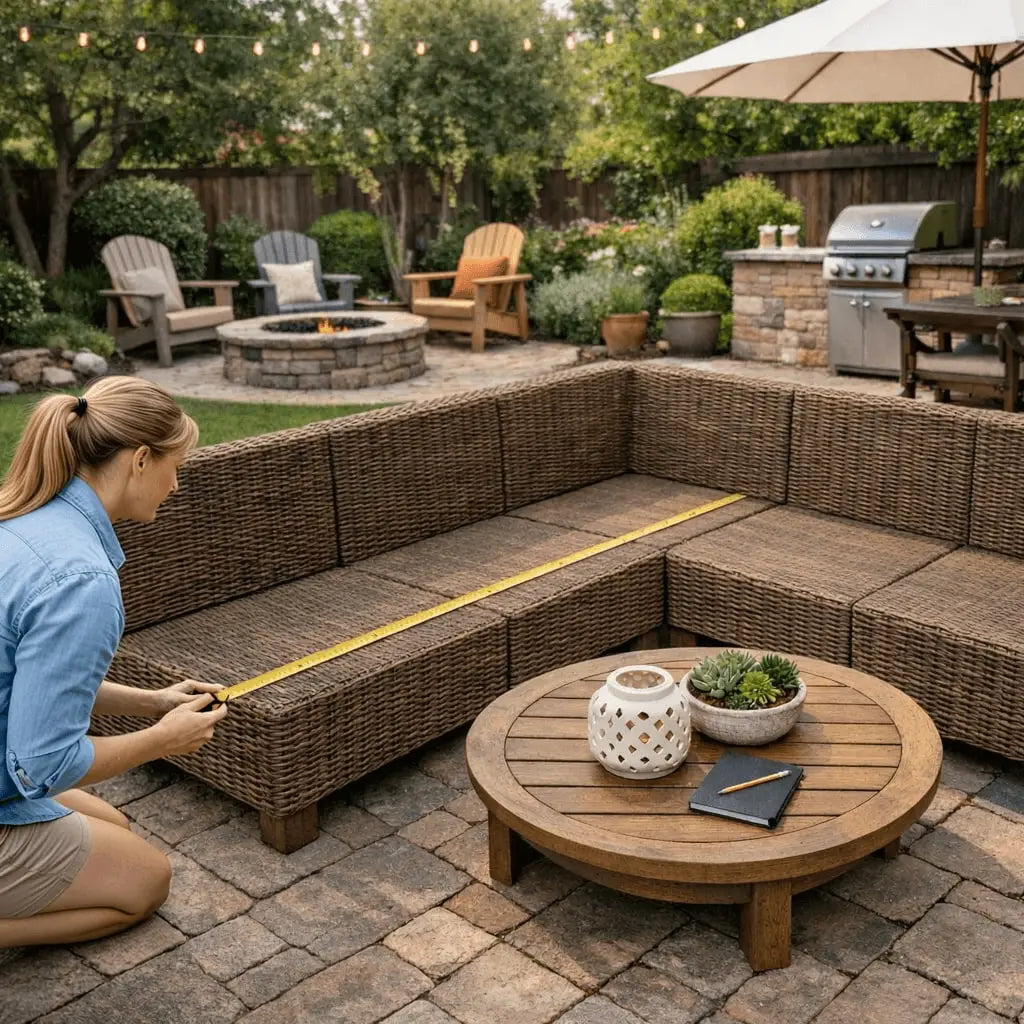
How to Measure Outdoor Cushions for the Perfect Fit
To measure outdoor cushions, measure the inside width and inside depth of your furniture frame in inches. For back cushions, measure the inside width and height. Always measure the inner seating area, not the outside of the furniture frame. If you are replacing an existing cushion, measuring the old cushion directly is also a reliable method.
In This Guide:
- What You Need Before You Start
- How to Measure Seat Cushions
- How to Measure Back Cushions
- How to Measure Bench Cushions
- How to Measure Deep Seat Cushions
- How to Measure Chaise Lounge Cushions
- How to Measure Porch Swing Cushions
- How to Measure Replacement Cushions
- Common Measuring Mistakes to Avoid
- What to Do If Your Size Is Non-Standard
- FAQ
Getting the right cushion size is the most important step when ordering custom or replacement outdoor cushions. A cushion that is even one or two inches too wide or too short can look off and may shift around during use. This guide covers how to measure outdoor cushions for every common furniture type, including chairs, benches, deep seat lounge furniture, chaise lounges, and porch swings. It also covers the most common measuring mistakes and what to do when your furniture uses a non-standard size.
 1. What You Need Before You Start
Before you start measuring, gather the following:
- A flexible tape measure (cloth or plastic tape measures work better than metal ones for curved furniture)
- A pen and paper, or your phone to record measurements
- The existing cushion if you are replacing one
- A photo of your furniture (helpful for unusual shapes)
Measure in inches. Most outdoor cushion brands, including Favoyard, use inches as the standard unit for custom orders.
2. How to Measure Seat Cushions for Outdoor Chairs
Seat cushions for standard patio and dining chairs are the most common type of outdoor cushion. Here is how to measure them correctly.
Step 1 — Measure the Seat Width
Measure from the left inside edge of the seat frame to the right inside edge of the seat frame. Measure at the widest point of the seating area. On most chairs, this is along the front edge of the seat. Write this number down. This is your cushion width.
Step 2 — Measure the Seat Depth
Measure from the front inside edge of the seat frame to the back inside edge of the seat frame. This gives you the front-to-back measurement of the seating area. Write this number down. This is your cushion depth.
Step 3 — Choose Your Thickness
Thickness is not something you measure from the furniture — it is a choice you make based on how you will use the cushion. For dining chairs and standard patio chairs: - 2 inches: firm, low-profile, good for upright dining seating - 3 inches: moderate cushioning, the most common choice for everyday patio chairs See our [Outdoor Cushion Thickness Guide] for more detail.
What to Measure — Chair Seat Summary
Measurement What to Measure Width Inside left to inside right of seat frame Depth Inside front to inside back of seat frame Thickness Your choice based on use and preference.
3. How to Measure Back Cushions for Outdoor Chairs
If your chair has a separate back cushion, measure it independently from the seat cushion.
Step 1 — Measure the Back Width
Measure the inside width of the chair back frame from left to right at the widest point.
Step 2 — Measure the Back Height
Measure from the bottom of the back frame to the top of the back frame. If the chair back is curved or angled, measure straight up rather than following the curve of the frame.
Step 3 — Note the Shape
Most chair back cushions are rectangular. If your chair back has a curved top or tapered sides, note this when ordering so the shape can be adjusted.
Back Cushion Summary
| Measurement | What to Measure |
| Width | Inside left to inside right of back frame |
| Height | Inside bottom to inside top of back frame |
| Shape | Note any curves, tapers, or unusual angles |
4. How to Measure Bench Cushions
Bench cushions are longer than chair cushions and may need to account for armrests or end panels on some bench styles.
Step 1 — Measure the Bench Length
Measure from the inside left edge to the inside right edge of the bench seat. If the bench has armrests on both ends, measure between the inner faces of the armrests, not across the entire bench. If the bench has no armrests, measure the full usable seating length.
Step 2 — Measure the Bench Depth
Measure from the front inside edge to the back inside edge of the bench seat. Most outdoor bench seats are between 16 and 20 inches deep.
Step 3 — Check for Cutouts
Some bench designs have armrests that sit partway along the bench rather than at the ends. If this is the case, you may need a cushion with notch cutouts to fit around the armrest posts. If your bench has this design, take a photo and include it when placing your custom order and contacting us so the shape can be cut correctly.
Bench Cushion Summary
| Measurement | What to Measure |
| Width | Inside left to inside right (between armrests if present) |
| Height | Inside front to inside back of bench seat |
| Shape | Note any armrest posts or obstructions within the seat area |
5. How to Measure Deep Seat Cushions
Deep seat outdoor furniture is designed for more relaxed, reclined seating and typically has much larger seat dimensions than dining chairs. Getting the measurements right is especially important because deep seat cushions are significantly more expensive to replace if they do not fit.
Step 1 — Measure the Seat Width
Measure the inside width of the seat from left to right. Most deep seat chairs range from 26 to 34 inches wide. Sectional pieces may be wider.
Step 2 — Measure the Seat Depth
Measure the inside depth of the seat from front to back. Deep seat furniture typically has a seat depth of 26 to 32 inches, which is significantly deeper than dining chairs. This is the measurement most people get wrong. Do not assume the depth — measure it directly.
Step 3 — Measure the Back Cushion Separately
Most deep seat furniture uses separate seat and back cushions. For the back cushion: - Measure the inside back width - Measure the inside back height Back cushions for deep seat furniture are typically 24 to 28 inches tall.
Step 4 — Choose Thickness
Deep seat lounge furniture generally uses thicker cushions: - 4 inches: standard deep seat cushion thickness - 5 inches: premium, maximum comfort option A thinner cushion on deep seat furniture will often look undersized and feel less comfortable.
Deep Seat Cushion Summary
Measurement What to Measure Seat Width Inside left to inside right of seat Seat Depth Inside front to inside back of seat Back Width Inside left to inside right of back frame Back Height Inside bottom to inside top of back frame Thickness 4"–5" recommended for deep seat
6. How to Measure Chaise Lounge Cushions
Chaise lounge cushions cover the full length of the chaise frame and are one of the most size-sensitive outdoor cushion types to measure correctly.
Step 1 — Measure the Full Length
Measure from the top of the headrest area to the bottom of the foot section along the inside of the frame. Some chaise lounges have an adjustable backrest. Measure with the backrest in its fully flat or most commonly used position.
Step 2 — Measure the Width
Measure the inside width of the chaise frame at the widest point. Chaise lounge cushions are typically 20 to 24 inches wide, though some wider models may be larger.
Step 3 — Note Any Split in the Cushion
Some chaise lounges use a two-piece cushion — one piece for the seat section and one piece for the adjustable backrest. If your chaise has an adjustable back, measure each section separately: Section 1: Seat area length × width Section 2: Back area length × width If you are ordering a single full-length cushion for a non-adjustable chaise, a single measurement is fine.
Chaise Lounge Cushion Summary
Measurement What to Measure Length Inside top to inside bottom of full chaise frame Width Inside left to inside right at widest point Split Note if you need a one-piece or two-piece cushion
7. How to Measure Porch Swing Cushions
Porch swing cushions are measured similarly to bench cushions, but you also need to account for how the cushion will be attached to the swing.
Porch swing cushions are measured similarly to bench cushions, but you also need to account for how the cushion will be attached to the swing.
Step 1 — Measure the Swing Width
Measure the inside width of the swing seat from left to right. Most porch swings range from 48 to 60 inches wide, though some models are wider.
Step 2 — Measure the Swing Depth
Measure the inside depth of the seat from front to back. Most swing seats are 18 to 22 inches deep.
Step 3 — Consider Ties
Because porch swings move, cushions can shift during use. Ties that attach to the swing frame slats are a practical add-on for swing cushions to keep the cushion in place. If your swing has slats or rails that ties can attach to, select the ties option when ordering.
Porch Swing Cushion Summary
| Measurement | What to Measure |
| Width | Inside left to inside right of swing seat |
| Height | Inside front to inside back of swing seat |
| Shape | Recommended for most porch swing applications |
8. How to Measure Replacement Cushions
If you are replacing old or worn outdoor cushions and the original cushions are still intact enough to measure, measuring the old cushion directly is often the most reliable method.
Measuring an Existing Cushion
Place the old cushion on a flat surface. Measure the width across the top surface at the widest point. Measure the depth from front to back at the deepest point. Measure the thickness from the top surface to the bottom at the thickest point. If the old cushion has compressed significantly with age, its current thickness may be less than the original. Consider ordering a slightly thicker cushion if you want to restore the original comfort level.
When the Old Cushion Is No Longer Usable
If the old cushion is too worn to measure accurately, measure the furniture frame directly using the steps above for the relevant furniture type. If you have a label or tag from the original cushion that shows the size, use that as a starting reference and confirm against the frame measurement.
Common Measuring Mistakes to Avoid
These are the most frequent errors people make when measuring for outdoor cushions.
Mistake 1: Measuring the Outside of the Frame
The most common mistake is measuring the total outer width or depth of the furniture, rather than the inner seating area. The cushion needs to fit inside the frame, not match the frame's total outer dimensions. Always measure the inside of the frame — the actual area where the cushion will sit.
Mistake 2: Only Measuring Width, Not Depth
Many people measure the width of the seat but forget to measure the depth. A cushion that is the right width but too short or too deep front-to-back will either fall off the seat or bunch up against the back frame. Always measure both dimensions.
Mistake 3: Not Accounting for Armrest Cutouts
On some bench and loveseat designs, armrests are positioned within the seating area. A standard rectangular cushion will not fit correctly around these armrests. If your furniture has armrests that interrupt the seating surface, you need a cushion with cutouts or notches. Note the position and size of the armrest posts when ordering or contacting us.
Mistake 4: Assuming Standard Sizes Fit
Even furniture from well-known brands does not always use standard cushion sizes. Manufacturing tolerances, older models, and international brands can all result in dimensions that fall outside standard cushion sizes. Measure your furniture directly rather than assuming a standard size will fit.
Mistake 5: Rounding Up Too Much
It is generally better to use your exact measurement or round down slightly rather than rounding up. A cushion that is slightly too large will overhang the frame and look and feel off. If your measurement falls between whole inches, round down to the nearest half inch for a snug fit.
Mistake 6: Forgetting to Measure Thickness
Thickness affects how the cushion looks and feels, and also affects how it fits within the chair frame. Some chairs have armrests at a fixed height — a cushion that is too thick may sit above the armrest level, which feels awkward. Consider the relationship between cushion thickness and armrest height when choosing thickness for chairs with fixed armrests.
10. What to Do If Your Size Is Non-Standard
If your measurement does not match any standard cushion size, you are not alone. Older patio furniture, imported sets, and custom-built outdoor furniture frequently use dimensions that fall outside standard ranges. A few options: Option 1: Order a custom cushion This is usually the most reliable solution. Brands like Favoyard allow you to specify any width, depth, and thickness when ordering, so you can get a cushion made to your exact dimensions. Option 2: Trim a larger cushion Some standard cushions can be trimmed to fit, though this depends on the construction and fill type. This option works better for simple rectangular shapes and generally gives less precise results than ordering custom. Option 3: Measure and recheck If your measurement seems very unusual, remeasure before ordering. An unexpected result is sometimes a measuring error rather than a genuinely unusual furniture size. For non-standard sizes, odd shapes, or built-in furniture, contact Favoyard directly and we can help confirm your measurements before you place your order.
11. Frequently Asked Questions
Q1:
Should I measure the inside or outside of the furniture frame?
A1:
Always measure the inside of the frame — the actual seating area where the cushion will sit. Measuring the outside of the frame will give you a number that is too large.
Q2:
How much smaller should the cushion be than the frame measurement?
A2:
In most cases, ordering the cushion at your exact inside frame measurement gives a good fit. If you prefer a slightly looser fit, you can subtract half an inch from each dimension. Avoid ordering a cushion larger than the inside frame measurement.
Q3:
What if my furniture has curved or angled sides?
A3:
For curved or angled furniture, measure the widest point of the inside seating area. If the shape is significantly irregular, consider a custom-shaped cushion and provide a photo or diagram when ordering and contacting us.
Q4:
Can I use centimeters instead of inches?
A4:
Favoyard uses inches as the standard unit for custom orders. If you have measurements in centimeters, divide by 2.54 to convert to inches before ordering.
Q5:
My old cushion is a non-standard size. Can I still get a replacement?
A5:
Yes. Favoyard custom outdoor cushions are available in any size, so non-standard dimensions are not a problem. Measure your old cushion directly or measure the furniture frame and order to those exact dimensions.
Q6:
How do I measure for a two-piece chaise lounge cushion?
A6:
Measure the seat section and the back section separately. For each section, measure the inside width and the inside length. Order two separate cushions using these measurements.
Q7:
What if my measurement falls between standard sizes?
A7:
With a custom cushion, this is not an issue — you simply order the exact dimension you measured. If you are ordering a ready-made cushion, choose the nearest size that fits within the frame rather than the nearest size that exceeds it.
Getting your measurements right before ordering is the single most effective way to make sure your outdoor cushions fit well and look good. Take your time with each measurement, double-check before you order, and note any unusual shapes or features that might affect the cushion design. If you are unsure about your measurements or have furniture with an unusual shape, Favoyard's team is happy to help confirm sizing before you place your order.
Ready to order?
Share:
Patio Cushion Replacement Guide: Refresh for Less (2026)
Outdoor Cushion Thickness Guide